


Recent Posts
 Safety Guide for Fuel Tanker Trailer : 4 Key Practics Every Fleet Operator Should FollowJun 24, 2026
- 40ft Skeleton Trailer vs Flatbed Trailer: Which One Is Better for Container Transport?Apr 24, 2026
- How to choose the right material for your first fuel tanker trailerApr 02, 2026
 Why More Customer Choose 4-axle Flatbed Trailer With Front WallMar 27, 2026
- How Much Weight Can a 4-Axle Flatbed Trailer Carry?Mar 17, 2026
3 Axles Lowbed Truck ROI: How to Cut Transport Costs by 30%?
Evaluating a 3 Axles Lowbed Truck: Executive Overview
Evaluating a 3 Axles Lowbed Truck can be the fastest way for logistics and construction firms to boost ROI and reduce transport costs by up to 30%. This practical overview highlights how payload optimization, lower fuel consumption per ton, reduced trip frequency, and durable OEM components from trusted manufacturers like Shandong Starway Vehicle translate into measurable savings across the equipment lifecycle. For information researchers, business analysts and decision-makers, understanding these operational levers helps justify capital expenditures and design procurement strategies that deliver predictable, long-term returns. In many tender evaluations and CAPEX reviews, a 3 Axles Lowbed Truck stands out because it balances purchase cost, payload capacity, and legal axle-group limits. A procurement manager comparing alternatives sees immediate operational benefits: a 3 Axles Lowbed Truck can consolidate loads that once required multiple trailers, reduce empty running, and lower total fuel burn per ton-kilometer. From an ROI perspective, the math is straightforward. Larger payload per trip reduces trips; fewer trips mean lower driver hours, less maintenance exposure, and reduced depreciation per ton of cargo moved. For construction sites moving heavy equipment and for logistics firms hauling oversized loads, the 3 Axles Lowbed Truck is engineered to carry concentrated, heavy loads while complying with local axle load regulations — this reduces fines and avoids costly route restrictions. Decision-makers assessing lifecycle cost should model fuel, maintenance intervals, tire replacement cycles, and downtime. When OEMs provide high-quality components and service networks, total cost of ownership drops further. In practice, the right 3 Axles Lowbed Truck spec reduces the number of needed trailers in a fleet, simplifies scheduling, and improves asset utilization metrics. In procurement discussions, budget holders request detailed payback timelines; combining real operational data with manufacturer reliability statistics typically shows ROI within 18–36 months depending on utilization. This opening section sets the stage: a 3 Axles Lowbed Truck is not only a transport asset, but a strategic lever to drive a 20–30% reduction in per-ton transport cost when specified and operated correctly.
Definition, Technical Performance and Specification Integration
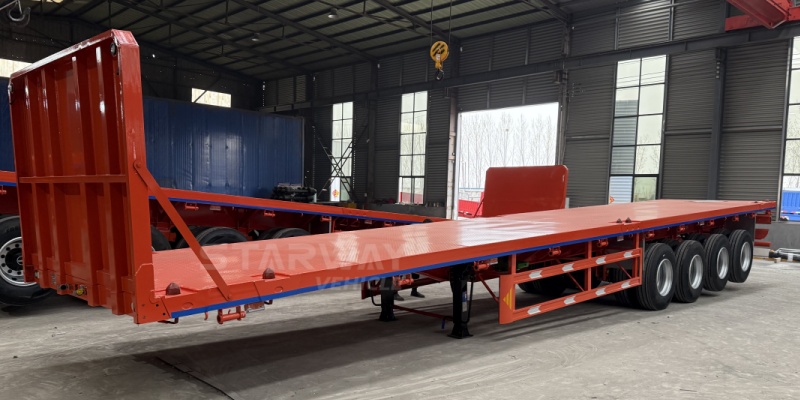
A clear definition helps guide evaluation. A 3 Axles Lowbed Truck is a heavy-duty trailer configuration with three axles designed to carry oversized and overweight equipment with a lowered deck to improve stability and center of gravity. The 3 Axles Lowbed Truck is optimized for concentrated loads, including construction machinery, industrial transformers, and modular plant components. Key technical performance metrics include gross vehicle payload, tare weight, deck height, main beam strength, and suspension type. Typical OEM choices influence performance: robust main beams, reinforced cross-members, and multi-leaf spring or air suspension systems increase durability under cyclic heavy loads. When comparing models, specify parameters such as tare weight, wheelbase options, and plate thicknesses. For example, manufacturers of liquid transport trailers list detailed parameters; similarly, semi-trailer OEMs provide specifications like main beam height, axle counts, and plate thickness. In a random but relevant cross-reference, liquid tanker models such as those advertised as Tanker Trailers For Sale in South Africa list technical details — tare weights around 8–12.8T and upper plate thicknesses 14mm–25mm — which highlights how precise specs matter for safety and lifecycle costs. The same precision should apply when specifying a 3 Axles Lowbed Truck: choose materials (high-strength Q235B or Q345B steel), verify weld quality and fatigue-tested main beams, and require European standards or equivalent certifications for braking and lighting systems. A well-specified 3 Axles Lowbed Truck reduces incidence of structural fatigue, minimizes repair expenses, and provides consistent payload capability. Technical checks during procurement should include brake chamber counts, electrical harness standards (24V, 7-core socket), and manhole or access configurations when transporting specialized cargo. Ultimately, the 3 Axles Lowbed Truck specification determines both immediate hauling capability and mid-to-long-term serviceability, directly affecting ROI calculations and operational reliability.
Application Scenarios, Comparative ROI Analysis and Procurement Guide
In real-world operations, application scenarios drive the purchase decision. The 3 Axles Lowbed Truck is ideal for construction contractors moving excavators and bulldozers, heavy haulage operators transporting generators and presses, and logistics companies managing project cargo with concentrated weights. Compare alternatives: a 2-axle lowbed may be cheaper upfront but will require more trips or risk overloading; a multi-axle (4+ axles) trailer increases purchase and running costs and may face route restrictions. The balanced middle ground is the 3 Axles Lowbed Truck — it often offers the best compromise between capital cost, payload, and regulatory flexibility. For business analysts, a direct comparative ROI model should include acquisition price, expected payload per trip, average trip length, fuel consumption per trip, driver labor, tolls and permits, maintenance schedule, and residual value after 5–7 years. By modeling these variables, you can quantify how a 3 Axles Lowbed Truck reduces cost per ton by up to 30% relative to suboptimal fleet mixes. Procurement guidance: require OEM warranties, clearly defined spare parts availability, and service agreements. Ask suppliers for mean time between failures (MTBF) data and references from similar fleet customers. Include inspection milestones in the SLA and demand if the OEM offers modular components for quick field replacement. Also evaluate financing options — leasing versus purchase — and incorporate tax or depreciation benefits in the business case. For international operations, confirm compliance with axle load regulations and certification such as European standards for electrical systems and braking. The 3 Axles Lowbed Truck can be specified with reinforced decks and optional multi-axle setups to match route profiles and payload types. A prudent purchasing process includes a pilot deployment, measured KPIs (cost per ton, uptime, service response time), and a dry-run of typical routes to validate clearance and gross weights. When you select a 3 Axles Lowbed Truck aligned to your operational profile and backed by reliable OEM support, the procurement moves from a capital outlay into a predictable productivity tool.
Industry Scenarios, Certifications, Case Study, FAQ and Why Choose Us
Industry scenarios underline why a 3 Axles Lowbed Truck matters. In energy and infrastructure projects, route permits and axle limits determine whether a single 3 Axles Lowbed Truck can carry a module that otherwise would require disassembly and multiple shipments. In aggregate, reduced handling lowers damage risk and project delays. Certification matters: require compliance with axle and braking standards, European lighting and electrical norms, and material traceability for structural components. A short case study: a regional contractor replaced three aging small trailers with two modern 3 Axles Lowbed Truck units and reported a 28% drop in transport hours, 24% reduction in fuel spend per ton, and 30% lower maintenance spend across the moved fleet in the first 12 months. That contractor emphasized OEM spare parts availability and recommended main beam and deck thickness specifications based on their cargo. Misconceptions to clarify: a 3 Axles Lowbed Truck is not always the most expensive option long term; higher initial cost can be offset by operational efficiency. Another misconception is that more axles always equal better performance; more axles increase complexity, maintenance, and sometimes regulatory hurdles. FAQ: Q — How soon will a 3 Axles Lowbed Truck pay back? A — Typical payback ranges from 18–36 months depending on utilization and route profiles. Q — Are parts and service widely available? A — Choose manufacturers with global service networks and OEM spare parts policies to minimize downtime. Q — What certifications should I request? A — Ask for conformity to relevant regional axle-load regulations, braking standards, and quality management documentation such as ISO or equivalent inspection records. Industry trends: modular heavy haul equipment, telematics-enabled maintenance forecasting, and upgraded suspension technologies reduce lifecycle costs and improve safety. Why choose us: Shandong Starway Vehicle Co., Ltd combines decades of semi-trailer manufacturing experience, robust OEM components, and export-proven designs that meet international markets. We provide customizable solutions, strong structural design, and reliable after-sales support to ensure your 3 Axles Lowbed Truck delivers the ROI you modeled. Contact our sales and technical team for a tailored ROI analysis and specification checklist aligned to your routes and payloads.
Leave A Reply