


Recent Posts
 How to Choose the Right Fuel Tanker Trailer for Your Business?Nov 10, 2026
 Safety Guide for Fuel Tanker Trailer : 4 Key Practics Every Fleet Operator Should FollowJun 24, 2026
- 4 Axle Flatbed Semi Trailer Ready for Shipment to CongoJun 22, 2026
- 40ft Skeleton Trailer vs Flatbed Trailer: Which One Is Better for Container Transport?Apr 24, 2026
- How to choose the right material for your first fuel tanker trailerApr 02, 2026
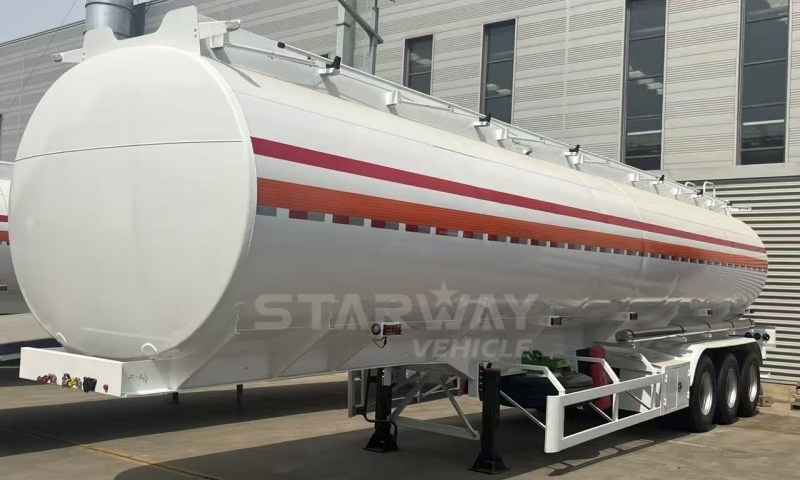
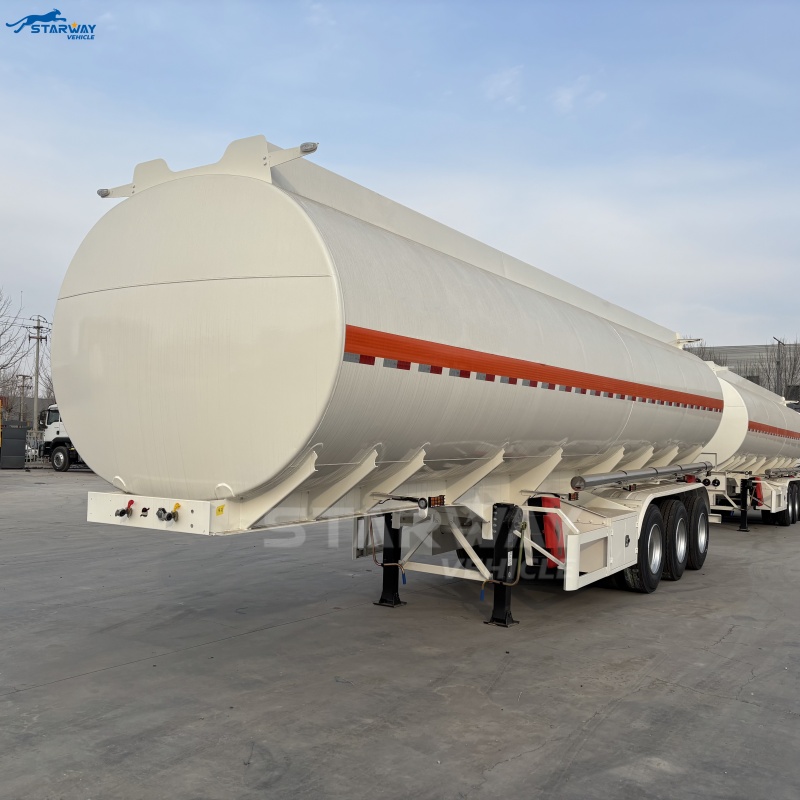

How to Choose the Right Fuel Tanker Trailer for Your Business?
When customers ask us about fuel tanker trailers, two questions usually come first: How much does it cost, and how many liters can it carry?
Both are important. But from our experience, these are not the only things worth discussing before placing an order.
Think about your daily transport work. Are you mainly carrying diesel? How far does the truck travel? Will it run on highways, or does it also
need to deal with rough roads? You should also check the axle weight limits in your country.
A tanker that works well for one transport company may not be suitable for another. That's why we always recommend looking at the actual
working conditions before choosing a model.
At Starway Vehicle, we build fuel tanker trailers for different markets and transport needs. Here are a few things to keep in mind when selecting one.
1. Choose the Right Capacity and Axle Configuration
Most fuel tanker trailers we discuss with customers fall within the 30,000L to 60,000L range. The right capacity, however, is not simply a matter of
choosing the largest tank available.
Fuel density, the trailer's own weight, expected payload, and local gross vehicle weight (GVW) limits all need to be considered. Axle configuration
is another part of the decision
Here is a general look at the three options:
We mainly manufacture 3-axle and 4-axle fuel tanker trailers. A 5-axle design can also be discussed if the customer's transport needs call for it.
One thing to remember: more axles do not automatically mean a higher legal payload. The tank, chassis, suspension, tires, and axle ratings all have to match.
2. Which Tank Material Should You Choose?
The material you choose will affect the trailer's weight, cost, and maintenance. It also needs to be suitable for the liquid being transported.
The three materials most commonly considered are:
For many diesel transport businesses, carbon steel is a practical option. It offers good strength without making the purchase cost unnecessarily high.
Stainless steel is worth considering when the cargo requires better corrosion resistance. Aluminum alloy is different: its main advantage is lower weight,
which may help increase payload within the legal limit.
You don't necessarily need the most expensive material. What matters is choosing one that fits your cargo and operating conditions.
3. How Many Compartments Do You Need?
This is mainly about how you deliver fuel.
If your trucks carry one type of fuel from a depot to a single destination, one compartment may be all you need. But things are different when you supply
several customers on the same route or transport different fuel products.
Fuel tanker trailers can be designed with 1 to 6 compartments, depending on the tank capacity and layout.
For example, a multi-compartment tanker allows you to carry different products separately in one trip. It can be a practical solution for fuel distributors who deliver
to several stations or customers.
Before confirming the design, consider your usual delivery routine:
How many delivery stops does one truck normally make?
Do you need to carry different fuel products?
How much does each customer usually order?
These questions will help us work out a compartment layout that makes sense for your business.
Fuel tanker trailers can be designed with 1 to 6 compartments, depending on the tank capacity and layout.
For example, a multi-compartment tanker allows you to carry different products separately in one trip. It can be a practical solution for fuel distributors who
deliver to several stations or customers.
Before confirming the design, consider your usual delivery routine:
How many delivery stops does one truck normally make?
Do you need to carry different fuel products?
How much does each customer usually order?
These questions will help us work out a compartment layout that makes sense for your business.
4. Don't Overlook the Loading and Discharge System
A fuel tanker trailer also needs the right loading and unloading equipment. This part is sometimes overlooked when customers focus too much on tank capacity and price.
Depending on the application, the trailer can be fitted with bottom loading valves, discharge pipelines, manholes, and other related equipment.
Vapor recovery systems may also be required in certain markets.
There is one detail you should confirm early: the connection standards used at your fuel depot.
If the equipment does not match your existing facilities, modifications may be needed after delivery. It is much easier to confirm these requirements before production begins.
5. Suspension, Tires, and Frame Strength for Rough Roads
For customers operating in Africa, road conditions are often an important part of the discussion. Some trucks spend most of their time on highways, while others regularly travel
on uneven rural roads or enter construction and mining sites.
These conditions put different demands on the trailer. Suspension, tires, axles, and frame construction all deserve attention.
Let's look at the two common suspension options:
Mechanical suspension is a common choice for customers who prefer a straightforward design and easier maintenance. Air suspension also has its advantages, particularly
when ride comfort is important.
Apart from suspension, don't forget these details:
Tires and Axles: Check the specifications, load ratings, and brands. They must be suitable for the trailer's intended operating weight.
Main Frame: The frame should be designed to handle the expected load and road conditions.
Welding Quality: Good welding and proper structural design help the trailer handle repeated use.
For remote areas where repair facilities are limited, a simple configuration that is easy to maintain can save a lot of trouble over time.
6. What Should You Check When Choosing a Manufacturer?
Price is important, but make sure you know what you are comparing.
Two fuel tanker trailers may look almost the same in photos. Once you check the details, however, you may find differences in steel thickness, tank material, axle brands, valves, suspension, and anti-corrosion treatment.
Ask for a detailed specification sheet before making a decision. Don't just compare the final price; check what is actually included.
It is also worth asking the manufacturer a few practical questions:
Can the trailer be customized to match your requirements?
Can you inspect it before shipment?
Are spare parts and technical support available after delivery?
What warranty is included?
At Starway Vehicle, we manufacture 3-axle, 4-axle, and 5-axle fuel tanker trailers for different transport applications. Customers can discuss the tank capacity, material, compartment layout, suspension, and equipment with our team before production.
We know that what matters most is how the trailer performs after it arrives at your destination. A clear specification and proper communication before production can help avoid many unnecessary problems later.
Leave A Reply