


Recent Posts
 Safety Guide for Fuel Tanker Trailer : 4 Key Practics Every Fleet Operator Should FollowJun 24, 2026
- 40ft Skeleton Trailer vs Flatbed Trailer: Which One Is Better for Container Transport?Apr 24, 2026
- How to choose the right material for your first fuel tanker trailerApr 02, 2026
 Why More Customer Choose 4-axle Flatbed Trailer With Front WallMar 27, 2026
- How Much Weight Can a 4-Axle Flatbed Trailer Carry?Mar 17, 2026
How Much Weight Can a 4-Axle Flatbed Trailer Carry?
How Much Weight Can a 4-Axle Flatbed Trailer Carry?
When it comes to heavy transport, one question is more important than others: how much weight can a 4-axle flatbed truck actually carry?
It's a vital calculation.Whether you're moving large steel structures,industrial machinery,or stacks of containers,getting the weight not only reduces
efficiencu and creates safety hazard but can also lead to hefty fines. Understanding trailer load limits is key to ensuring smooth and efficient transport
or avoiding logistical nightmare.
In this guide, we will detail the standard load capacity of 4axles flatbed trailer, the engineering principles behind it, and how to legally drive it.
Typical Load Capacity: Specific numbers
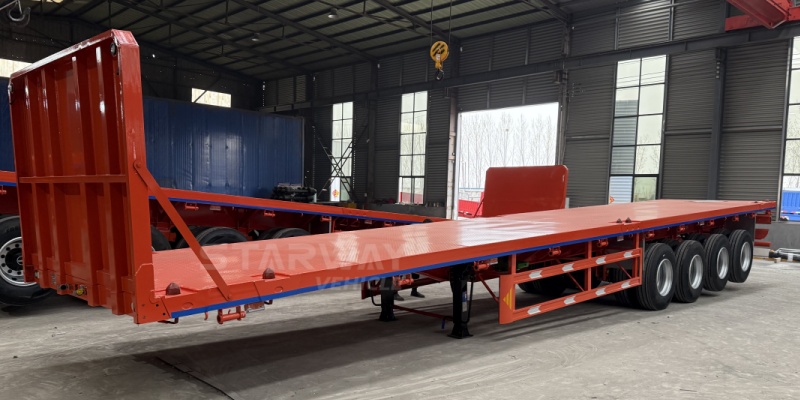
For most standard operations,the desogn load capcacity of 4-axle flatbed semi-trailer is between 60 and 80 tons.
Why the jump from a standard 3-axle? It’s simple physics. More wheels on the pavement means better weight distribution. By distributing the total tons across four
different points, stress on the chassis and tires can be significantly reduced.This not only increases the payload but also makes the entire trailer more stable at high speeds.
Keep in mind, though, that capacity isn't a single universal number. This depends on the manufacturer's manufacturing quality and the specific materials used in the frame.
Payload Structure: What Limits the Weight?
The strength of a trailer depends on its weakest point. The final safety rating depends on the following factors
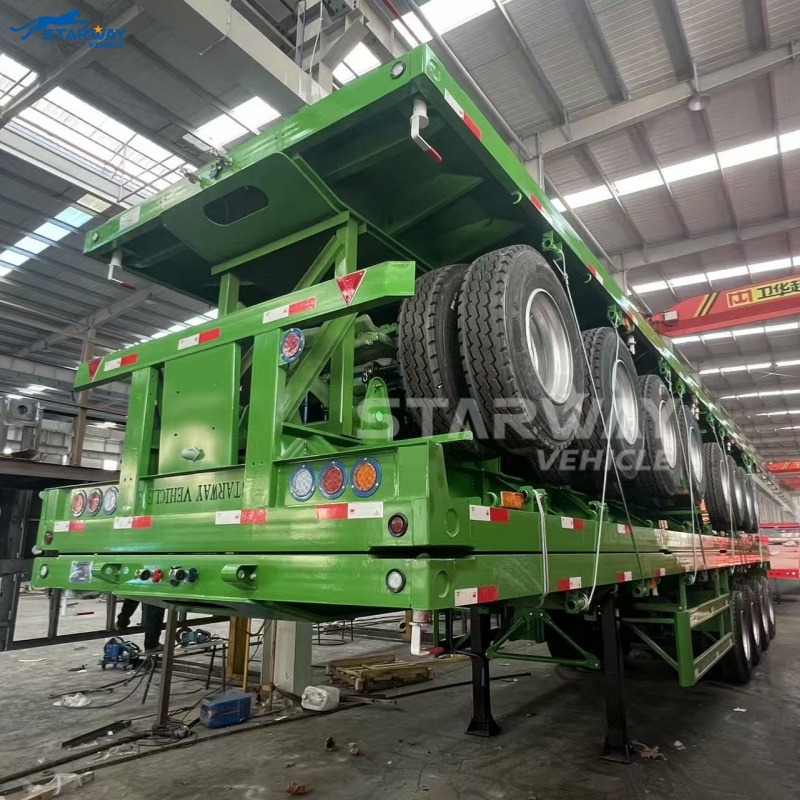
Frame Integrity: The backbone of the trailer.Top manufacturers typically use high-strength structural steel (such as Q345B) as the main beams. This provides the necessary
rigidity to prevent the trailer from sagging or bowing under a concentrated load.
Axle Ratings: Not all axles are the same. Many heavy-duty trailers uses 13-ton axles from well known brands like FUWA or BPW. When four axles work together, the total
loading capacity will be significantly increased compared to a lighter 2 or 3 axle configuration.
Suspension options: You've a variety of choices Mechanical leaf spring suspension is the industry workhorse—it's tough, simple in structure and can easily handle huge loads
However, air suspension is becoming more popular for sensitive cargo,it provides a smoother ride and better protection against road vibrations.
Tire Specs:Tires cannot be ignored. Heavy-duty transport trailers usually use 12R22.5 or 315/80R22.5 tires. If your tires are not strong enough to support the weight you
are towing, a tire blowout could happen at any time.
Real-world testing: Legal and Technical Limits The key point is: even if your trailer can carry 80 tons, it doesn't mean the law allows it.
Every region has its own Gross Vehicle Weight (GVW) and axle-load.Your trailer may be the sturdiest in your fleet, but if you exceed the local speed limit, you'll face cargo
impoundment and hefty fines. Always verify local transportation regulations or regional transport regulations before loading.
Why choose a 4axles configuration?
If your business involves the transportation of heavy goods, then a four-axle flatbed truck is usually the best choice :
Steel coils and raw construction materials.
Oversized industrial equipment and heavy machinery..
High-density infrastructure components.
The extra axle provides a safety margin that standard trailers simply can't match, offering better braking performance and less wear and tear on your tractor unit.
Four-axle flatbed trailers are a powerful force in heavy logistics, and when properly configured, they can easily carry 60-80 tons of cargo.
However, hardware is only half the battle.Successful heavy transport requires a balance between high-intensity engineering design, meticulous maintenance, and
strict adherence to road safety regulations.
Invest in quality steel and reliable axles, and your trailer will be an asset for years to come.
Leave A Reply