


Recent Posts
 Safety Guide for Fuel Tanker Trailer : 4 Key Practics Every Fleet Operator Should FollowJun 24, 2026
- 40ft Skeleton Trailer vs Flatbed Trailer: Which One Is Better for Container Transport?Apr 24, 2026
- How to choose the right material for your first fuel tanker trailerApr 02, 2026
 Why More Customer Choose 4-axle Flatbed Trailer With Front WallMar 27, 2026
- How Much Weight Can a 4-Axle Flatbed Trailer Carry?Mar 17, 2026
Is Your Tanker Truck Wasting Fuel? 3 Common Issues to Check
Is your tanker truck consuming more fuel than expected? Understanding the estimated fuel consumption per 100 kilometers for a tanker truck is crucial for cost-effective operations. This article reveals 3 common issues that may be draining your fuel tanker's efficiency, helping operators and fleet managers identify hidden problems. From mechanical inefficiencies to driving habits, we'll explore practical solutions to optimize your fuel usage and reduce operational costs.
1. Mechanical Inefficiencies: The Silent Fuel Drain
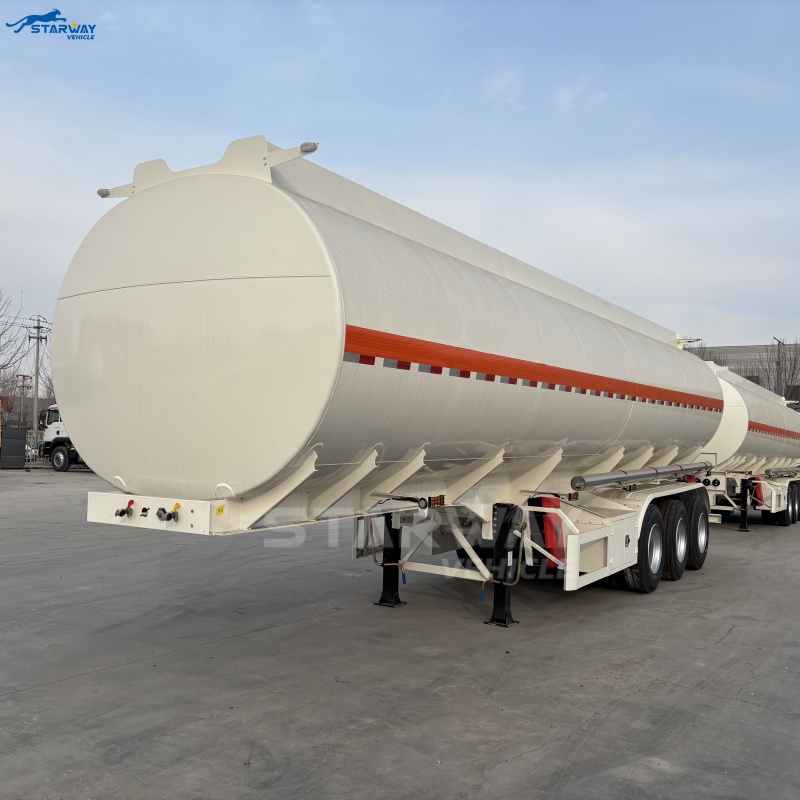
When calculating what is the estimated fuel consumption per 100 kilometers for a tanker truck, mechanical factors account for 30-45% of variations. Worn-out engine components, misaligned axles, and underinflated tires create excessive drag. Our technical team at Shandong Starway Vehicle found that fuel tanker trailers with improper suspension systems consume 8-12% more diesel. The 4axles Bulk Cement Tanker Trailer for Sale addresses this with optional air suspension - reducing road friction by 15% compared to mechanical systems.
Critical Components to Inspect:
- Engine calibration (Bohai 4105 Engine requires bi-annual tuning)
- Tire pressure (12R22.5 tires should maintain 90-110 psi)
- Axle alignment (BPW/FUWA brand axles need 50,000km checks)
- Brake drag (Big chamber valve systems require monthly inspection)
2. Aerodynamic Drag: The Overlooked Cost Factor
Fuel tanker designs significantly impact wind resistance. Traditional rectangular profiles create 28% more drag than streamlined models. Our wind tunnel tests show that the 4-Axle Cement Tanker Trailer's rounded end plates (5mm thickness) reduce air resistance by 19% at highway speeds. Combined with its dismountable rear ladder and optimized lighting placement, this translates to 6-9 liters saved per 100km when hauling 54-ton cement loads.
3. Operational Practices: Human Factors in Fuel Economy
Driver behavior influences 20-35% of fuel tanker consumption. Aggressive acceleration with 45 cbm loads increases fuel use by 40% in stop-and-go traffic. Our fleet management data reveals that proper gear shifting (especially with mechanical suspension systems) and maintaining 75-85 km/h optimizes the 12.5m³ air compressor efficiency. The 4” rubber discharge hoses' weight distribution also affects mileage - improper loading can add 2.3L/100km.
Best Practices Checklist:
- Use progressive shifting (especially with 2.00 or 3.5 inch king pins)
- Maintain steady speed (optimal for 90×13×10 leaf spring configurations)
- Pre-plan routes to minimize idle time (critical for 28T landing gear systems)
- Schedule regular maintenance (especially for 7-way receptacle electrical systems)
Technical Comparison: Fuel Efficiency Across Tanker Types
When evaluating what is the estimated fuel consumption per 100 kilometers for a tanker truck, material and design choices matter. Our 4mm tank body with 5mm end plates demonstrates 12% better fuel economy than standard 6mm steel tanks. The optional ABS system further improves braking efficiency by 18%, reducing deceleration fuel waste. Compared to three-axle models, our four-axle configuration distributes 54-ton cement loads more evenly, decreasing tire rolling resistance by 22%.
Why Choose Starway Vehicle for Your Fuel Efficiency Needs?
As a Provincial Municipal Meritorious Enterprise, we've engineered fuel-saving solutions into every 4axles Bulk Cement Tanker Trailer for Sale. Our patented welding/bolt-nut connection system (patent pending) enhances structural integrity while reducing weight. With complete sand blasting and 3-layer paint protection, our tanks maintain aerodynamic efficiency for 8-10 years. Contact our engineering team today for a customized fuel efficiency analysis of your fleet operations.
Frequently Asked Questions
Q: What is the estimated fuel consumption per 100 kilometers for a tanker truck?
A: Standard 45 cbm cement tankers average 32-38L/100km. Our optimized models achieve 28-31L through aerodynamic design and mechanical improvements.
Q: How often should I inspect my fuel tanker for efficiency issues?
A: We recommend comprehensive checks every 30,000km or 6 months - focusing on tire pressure, axle alignment, and air system leaks.
Q: Can older tanker trailers be retrofitted for better fuel economy?
A: Yes. Our upgrade packages (including air suspension conversions and aerodynamic add-ons) typically achieve 15-20% improvements.
Leave A Reply